Post-training quantization for World Action Models
QuantWAMs
Calibrating at the Right Granularity for World Action Models
Aligning every quantization decision with model structure, the joint video–action objective, and reachable closed-loop rollouts.
Fudan University · Shanghai Key Lab of Intelligent Information Processing · East China Normal University



WORLD / VIDEO01
PREDICT OBSERVATIONS
JOINT OBJECTIVE
ACTION / CONTROL02
GENERATE ACTIONS
W4A4DOMINANT
01 / OVERVIEW
Calibration context decides whether quantization transfers.
World Action Models jointly generate future video and actions. Every control cycle denoises iteratively, while early quantization errors alter the states encountered later in the closed loop.
Conventional PTQ methods usually assume open-loop objectives, homogeneous transformers, and static calibration samples. QuantWAMs places each precision decision back into the context it depends on: where evidence is pooled, which state distribution is measured, and which task objective scores it.
context=structure×distribution×objective
The same principle is instantiated with architecture-specific grouping rules for Fast-WAM and LingBot-VA, then evaluated on RoboTwin 2.0, LIBERO, and AgiBot G2 tasks.
02 / METHOD
One principle. Three calibration strategies.
From coordinate-compatible activation evidence to joint video–action gradients and reachable closed-loop states.
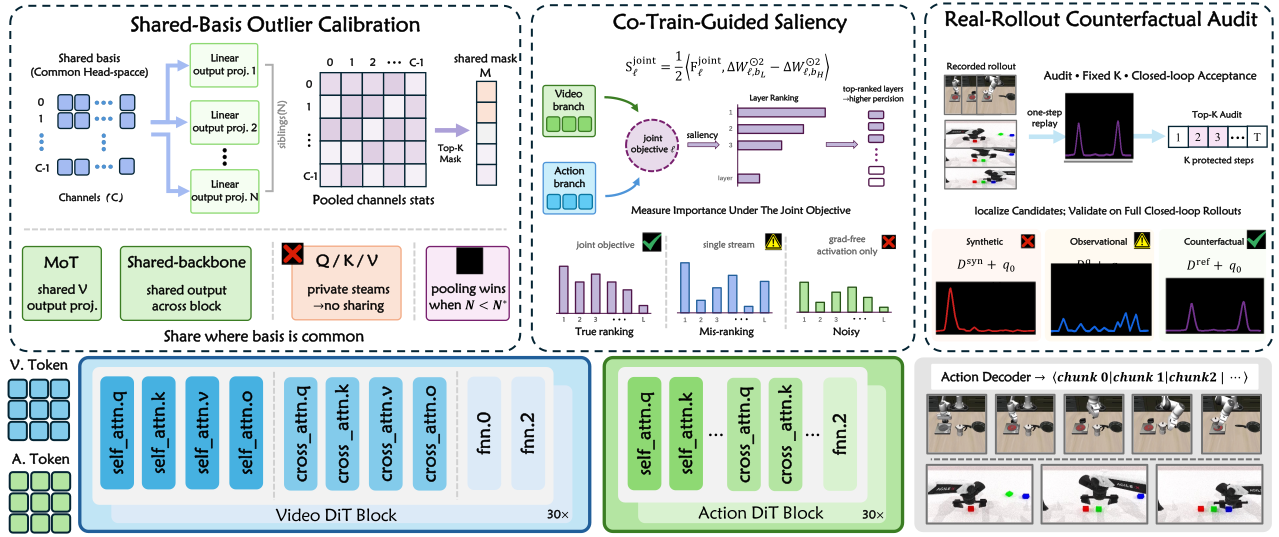
Shared-basis outlier calibration
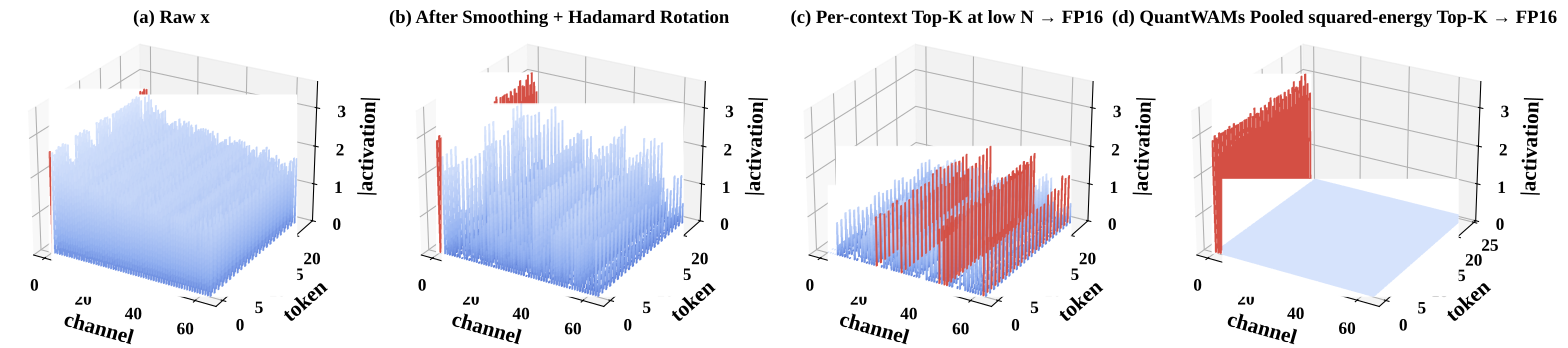
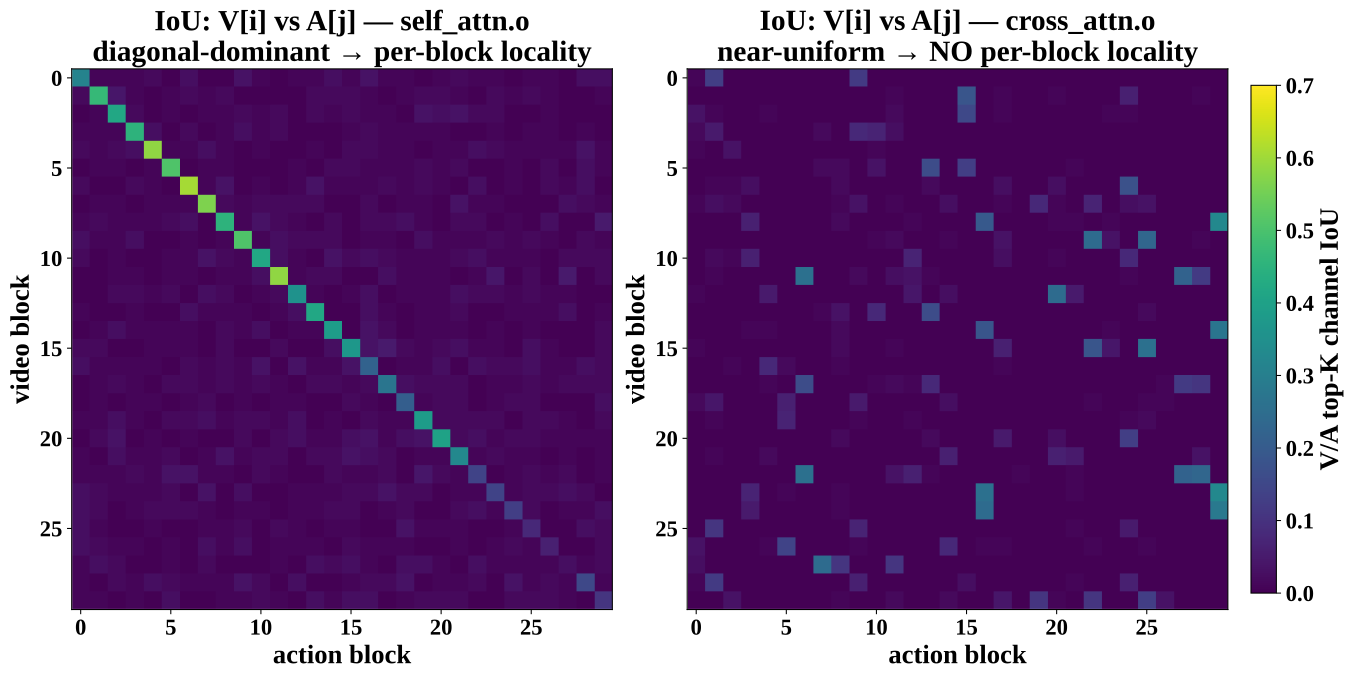
Pool channel energy only across coordinate-compatible modules, avoiding false sharing and unstable per-context Top-K masks at small sample counts.
STRUCTURECo-training-objective saliency
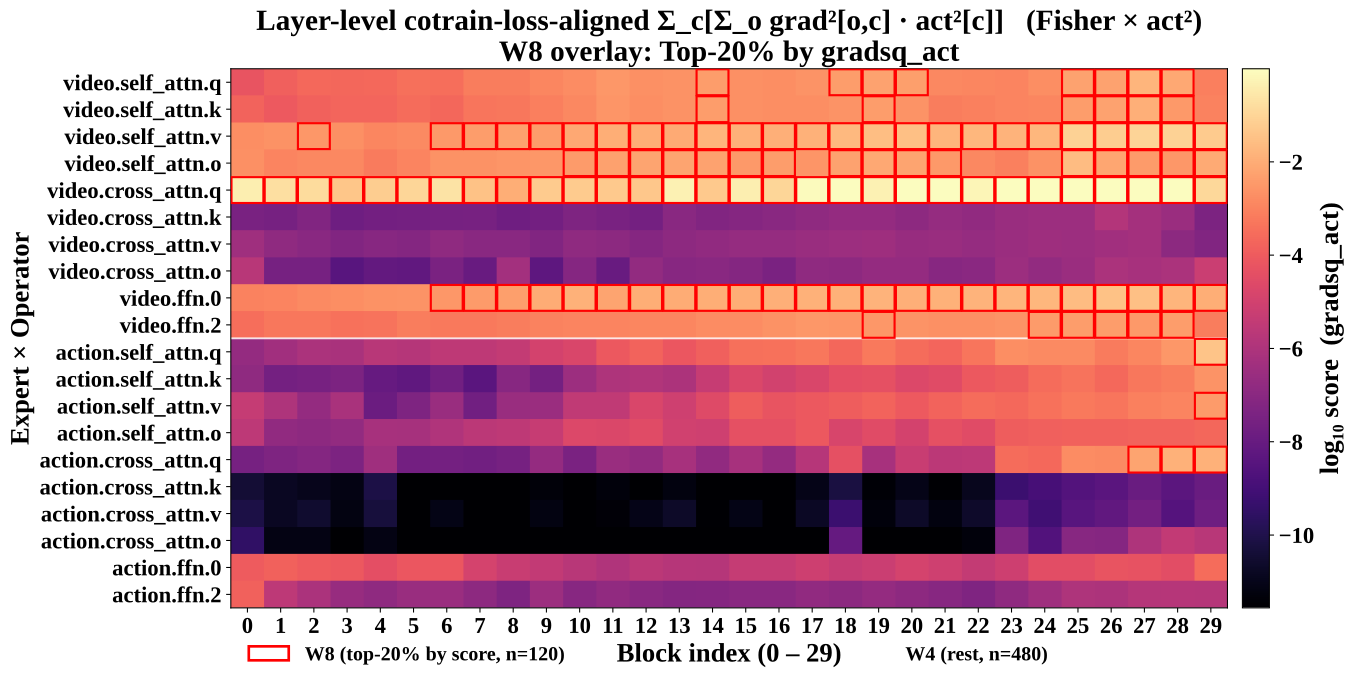
Allocate weight precision with empirical-Fisher scores from the joint video–action loss, using the more stable layer-level decision granularity.
OBJECTIVEFixed-intervention rollout auditing
Replay reachable states from real rollouts to revise denoising-step protection schedules without changing the precision budget.
DISTRIBUTIONINSIDE THE CALIBRATION
See why each granularity matters.
Diagnostics expose the evidence behind channel outliers, layer-level saliency, and trajectory resampling.
03 / RESULTS
Low bit. Closed-loop capability intact.
Success rate, block-level speed, and peak weight-plus-activation memory for the targeted blocks under the W4A4-dominant setting.
| Method | Precision | RoboTwin 2.0 | LIBERO avg. | Speedup | Memory (GB) |
|---|---|---|---|---|---|
| Full Precision | FP16 | 91.9% | 97.6% | 1.0× | 14.4 |
| GPTQ | W4A16 | 90.9% | 96.0% | 1.2–1.3× | 5.5 |
| SmoothQuant | W8A8 | 91.3% | 96.4% | 1.4–1.5× | 7.2 |
| SVDQuant | W4A4 | 61.1% | 73.7% | 1.6–1.7× | 3.6 |
| SVDQuant* | W4A4 | 65.9% | 75.3% | 1.5× | 4.2 |
| Atom | W4A4 | 71.7% | 76.2% | 1.6× | 3.8 |
| Atom* | W4A4 | 77.2% | 82.1% | 1.5–1.6× | 4.2 |
| QuantWAMs | W4A4 | 91.7% | 97.4% | 1.4–1.6× | 4.2 |
* SVDQuant* and Atom* use the same nominal mixed-precision allocation as QuantWAMs. Values are means over three paired protocol seeds; speed and memory are measured on targeted blocks.
RESOURCE PROFILE
About three-tenths of the peak memory.
On Fast-WAM’s targeted video and action blocks, peak weight-plus-activation memory falls from 14.4 GB to 4.2 GB.
04 / REAL ROBOT
From simulation to AgiBot G2.
QuantWAMs demonstrates deployment feasibility across one-arm pickup and dual-arm coordination tasks, retaining practical manipulation capability at W4A4.
56.7%Average across three tasks
1.4×Target-block speedup
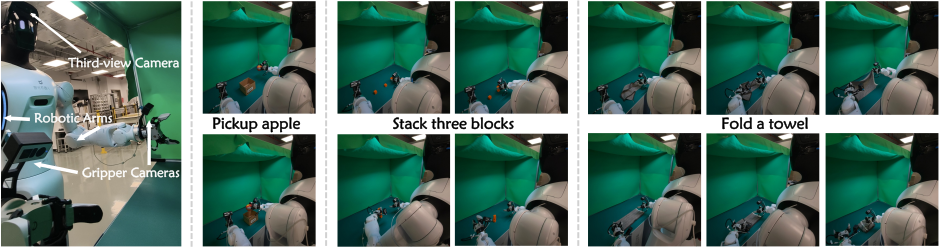
Pickup apple
8 / 10Stack three blocks
5 / 10Fold a towel
4 / 10TAKEAWAY
Quantizing a WAM is not only about choosing fewer bits. It is about choosing the right decision granularity with finite calibration data.
STRUCTUREOBJECTIVEDISTRIBUTION
05 / CITATION
Cite QuantWAMs
If this work supports your research, please consider citing it.
@misc{zhou2026quantwamscalibratingrightgranularity,
      title={QuantWAMs: Calibrating at the Right Granularity for World Action Models},
      author={Jiacheng Zhou and Jinfan Lv and Ruixuan Li and Longtai Zhang and Yan Wang and Wenqiang Zhang and Lizhe Qi},
      year={2026},
      eprint={2607.28405},
      archivePrefix={arXiv},
      primaryClass={cs.AI},
      url={https://arxiv.org/abs/2607.28405},
}